

Annual urban inflation in Egypt was 14.5% in August 2026, down from 24.1% in December 2024 and a record 38.0% in September 2023. Prices are still rising, only more slowly, so a budget written a year ago no longer matches your bills. The fix is to measure how much each of your own categories has moved and re-set its limit, rather than adding one percentage to everything.
What is Egypt's inflation rate in 2026?
As of August 2026, the Central Bank of Egypt puts annual urban inflation at 14.5%. It was 24.1% in December 2024 and peaked at 38.0% in September 2023, the highest on record. You may also see 12.7% quoted for the same month: that is CAPMAS's nationwide figure, which covers rural areas as well as cities.
An annual rate compares prices with the same month a year earlier. At 14.5%, something that cost 100 pounds in August 2025 cost about 114.5 pounds in August 2026, on average. A falling rate means prices are climbing more slowly. It does not mean they came down.
Which prices are rising fastest in 2026?
Not groceries. In August 2026 food prices were up 6.3% on the year, while non-food prices were up 19.5%. The biggest rise was in housing and in electricity and gas bills, and transport also rose faster than the average.
| Item | Rise over one year (urban, August 2026) |
|---|---|
| All items | 14.5% |
| Food and beverages | 6.3% |
| Everything except food | 19.5% |
| Housing, water, electricity, gas and fuel | 42.8% |
| Transport | 24.4% |
These are averages across all urban households. A household that spends most of its money on rent, bills and transport is facing a faster rise than one that spends most of it on food.
How do I measure my own household's price rise?
Compare what you spent on each category this month with what you spent on the same category in an earlier month. The same month last year is the best comparison, because electricity and school costs are seasonal. If you only started keeping records recently, compare with three months ago and repeat the comparison every month.
An example with round numbers, not a real household:
| Category | Same month last year | This month | Change |
|---|---|---|---|
| Market and groceries | 6,000 | 6,300 | +300 (5%) |
| Electricity and gas | 1,000 | 1,250 | +250 (25%) |
| Transport | 1,500 | 1,800 | +300 (20%) |
| Private lessons | 1,500 | 1,650 | +150 (10%) |
| Total | 10,000 | 11,000 | +1,000 (10%) |
In the example the total rose 10%, but the categories themselves rose by anything from 5% to 25%.
One caution: this measures spending, which is price multiplied by quantity. If you cut back on something, its number understates how much the price rose. That suits a budget, because the budget has to cover what you actually spend.
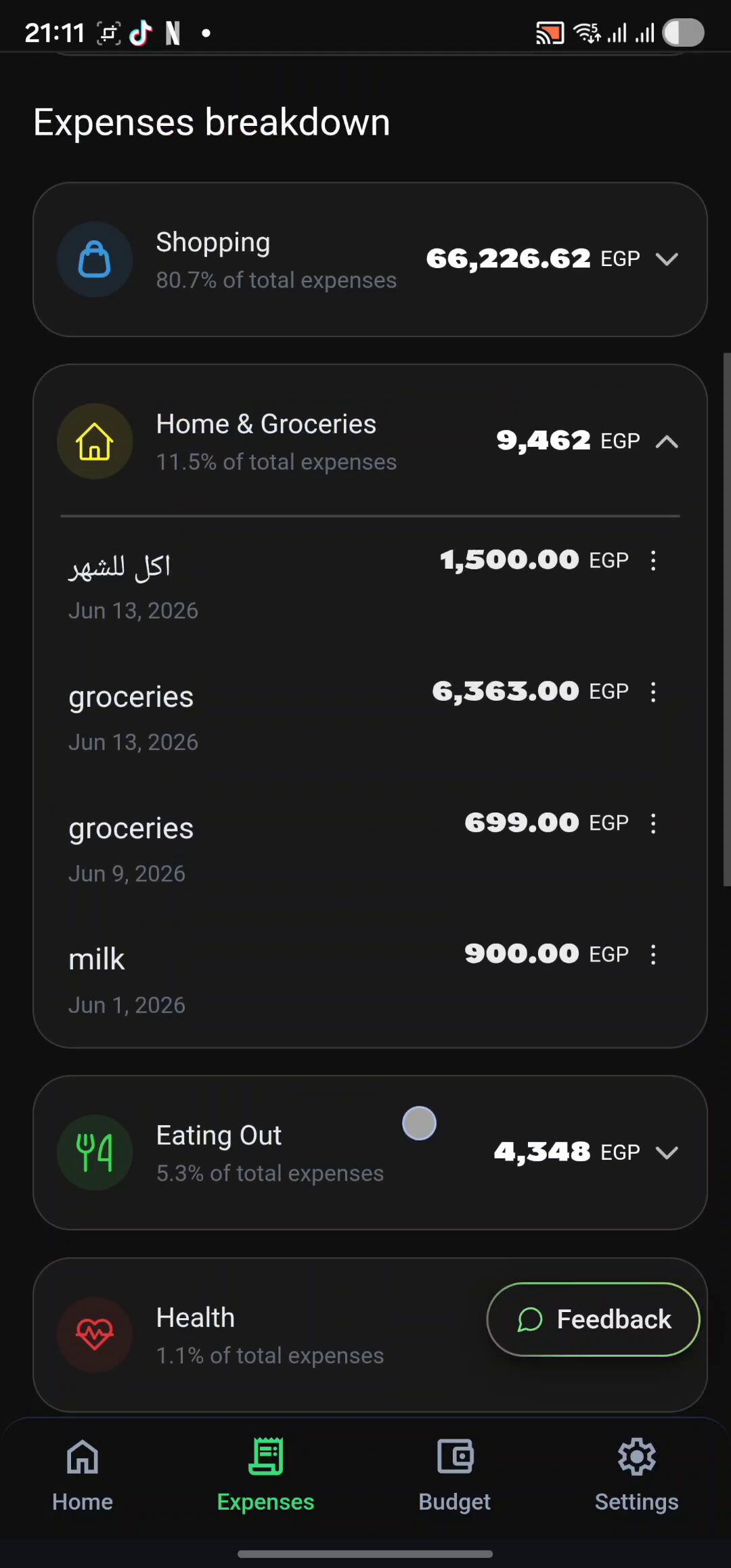
Any record works: a notebook, a spreadsheet or an app. Flosyfeen's Expenses screen shows the month's total and each category's share of it, so the per-category numbers are there without adding them up by hand. If you have no records yet, start by tracking your expenses for one month.
How do I update the budget when a bill goes up?
Change the limit of the category that moved, by the amount it moved. In the example, adding a flat 10% to all of last year's budget would give groceries 6,600 pounds, 300 more than is being spent on them, and give electricity and gas 1,100, which is 150 short. Transport would be 150 short as well.
So set each limit to what the category costs now, and change it in the month the change happens: when the electricity bill jumps, when the rent contract renews, when fares go up. A limit you overshoot every month has stopped telling you anything. If you don't have a budget yet, start with a monthly household budget from scratch.
What do I cut when the money doesn't stretch?
Split the budget into two lists. Fixed bills are the ones that have to be paid whatever happens: rent, school fees, internet, electricity and gas. Flexible categories are the ones you decide on day by day: eating out, clothes, outings, the kiosk.
In the example the household needs 1,000 pounds a month more than it did last year. If income rose by less than that, the difference has to come out of the flexible list. Decide now which category gives way first and which second, and write the order down. Choosing with the numbers in front of you is easier than choosing on the 25th, when the money is nearly gone. If a month still goes over, adjust the number and carry on.
Which price jumps can I plan for?
Some increases arrive on a date you already know:
- The new school year: fees, uniforms, books and the first month of private lessons come one after another when term starts.
- Summer electricity: the bill is higher in the months when the air conditioning and fans run most.
- Rent: if your contract has an annual increase, its date and percentage are written in it.
For each one, take the amount you expect and divide it by the months left. Example: a 6,000 pound school bill due in September, planned from March, is 1,000 pounds set aside each month from March to August.
Review the whole budget once a month, and again whenever one of these bills changes.
Sources
- Central Bank of Egypt — Inflation rates (urban headline, August 2026)
- Daily News Egypt — CBE explains drivers behind inflation slowdown in August 2026 (food and non-food)
- Enterprise — Urban inflation unexpectedly slowed to 14.5% in August (housing and transport)
- Ahram Online — Egypt annual headline inflation eases to 12.7% in August: CAPMAS (nationwide)
- CAPMAS — Central Agency for Public Mobilization and Statistics
- Daily News Egypt — CBE explains decline in inflation during December 2024
- Enterprise — Inflation accelerates again in September (2023 record)