Budget apps rarely stick in Egypt because nothing fills them in for you. None of the apps we compared lists a direct connection to an Egyptian bank, and very few people pay shops by card or phone, so every cash expense has to be typed or said by the person who spent it. What helps is making each entry as small as possible and logging it at the moment you pay.
Before you read: we make Flosyfeen, an expense tracker, so we have a stake in this subject. Every number below links to its source, and the advice works with any app or with a paper notebook.
Why can't a budget app in Egypt fill itself in?
Most advice about budget apps is written for countries where the app connects to your bank account and records each payment for you. That is not available here. YNAB, the American budgeting app, states that it does not support banks outside the US, Canada, the UK and parts of Europe. And in our comparison of seven expense apps available in Egypt, none lists a direct connection to an Egyptian bank.
So an expense reaches an app in one of three ways: you type it, you say it, or the app reads the SMS your bank sends after a card payment.
Don't apps that read bank SMS solve this?
For card payments, they help. If you pay mostly by card, an app that reads bank SMS records those payments without you doing anything, and that is a real advantage. The comparison lists which apps do it.
The limit is how few people pay by card or phone. In the World Bank's Global Findex survey, 5.2% of adults in Egypt made a digital merchant payment in 2024, up from 3.5% in 2021. That is a share of people, not of purchases, but it means most adults paid no shop digitally that year.
Cash sends no SMS. The market, the kiosk, transport, private lessons and the gam'eya instalment are only recorded if you type them or say them.
I stopped logging my expenses. Is it a discipline problem?
Stopping is the usual outcome, and not only in Egypt. Adjust, an app analytics company, reported for the first half of 2023 that roughly 1 in 10 people who install a finance app are still using it a month later. That figure covers all finance apps worldwide, including banking and payment apps. It is not specific to expense trackers or to Egypt.
Guessing is a poor substitute for a record, though. A 2022 study in the Journal of Marketing Research found that consumers under-predict their future spending. Its samples were in Canada, the UK and the US, not Egypt, so treat it as a general finding about people.
Taken together: a record is useful, and keeping one costs effort every time. We call the time between paying and writing it down the logging gap. That is our own label, not a scientific term. An expense left for later has to be remembered later, and small cash amounts are the easiest to forget. This is why the effort of one entry matters more than how many features an app has.
What actually helps you keep logging?
- Keep the entry small. One typed line or one spoken sentence with the amount and what it was for: "vegetables 150". Leave out notes and shop names.
- Log when you pay. Do it before the phone goes back in your bag, not at night from memory.
- Start with one week, and only the cash. Card payments leave a trace in your bank's messages or statement. Cash leaves none.
- Read it once a week. Look at the total for each category and see which ones are larger than you expected.
- If you miss a day, carry on from today. Don't try to rebuild what you missed.
After a week you can see where the cash went, category by category. That is enough to start a budget from real numbers, and a monthly household budget from scratch covers that next step.
An app, bank SMS or a notebook: which should I use?
- You spend mostly in cash: use whatever makes one entry quickest for you, by voice or by typing.
- You pay mostly by card: an app that reads bank SMS will record payments you would otherwise forget.
- A paper notebook works if you keep it up. It costs nothing and needs no phone, but you add up the totals yourself.
The comparison of expense apps in Egypt sets out what each app does and what it costs.
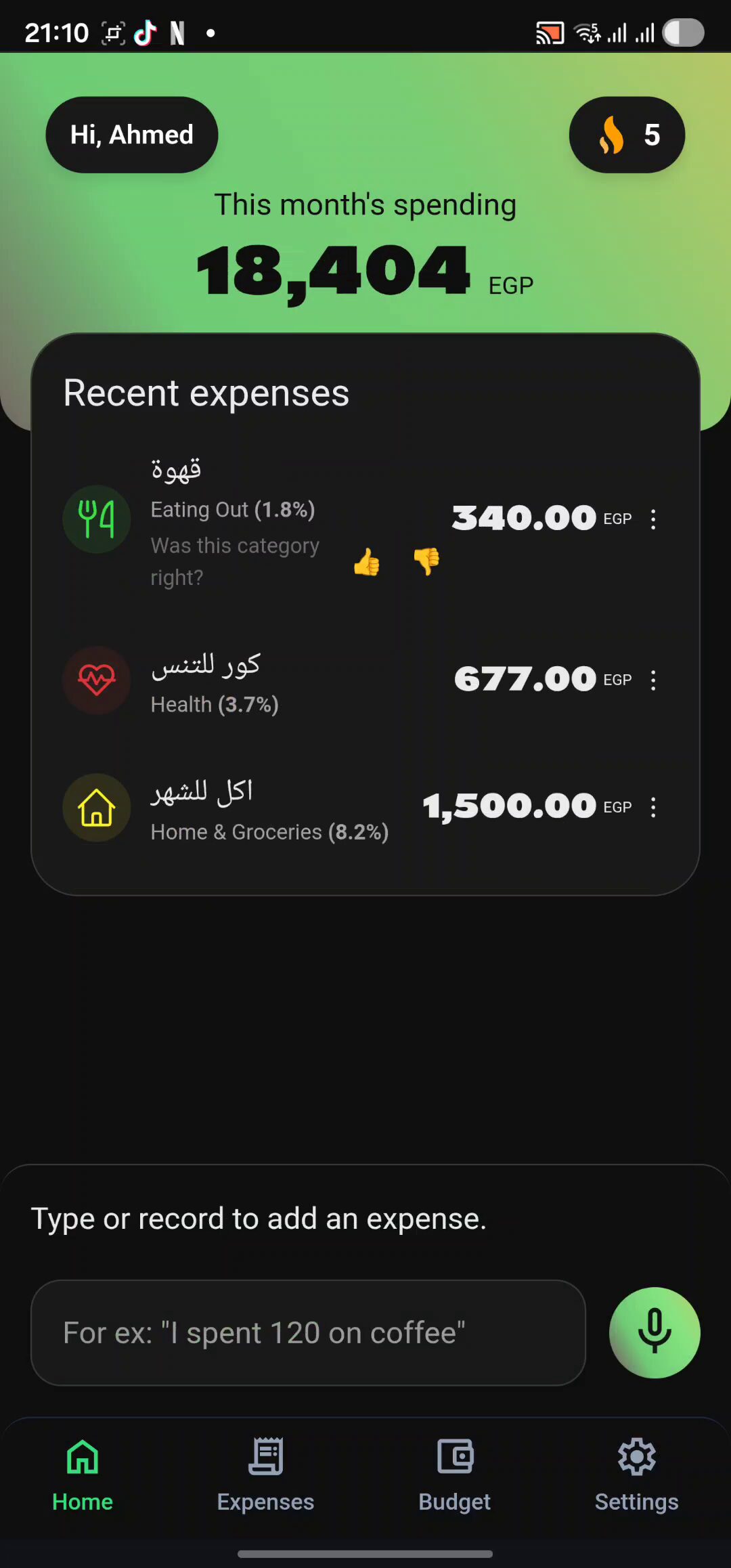
In Flosyfeen, the app we make, an expense is one sentence, spoken or typed, in Egyptian Arabic or English, and it files the amount, the category and the date. It opens in the browser, can be tried without an account, and never asks for bank details or SMS access. That also means it does not read bank SMS: a card payment is entered the same way as cash, by you.